
Zara’s mobile app (Photo by Abdulhamit Topal/Anadolu Agency/Getty Images) GETTY IMAGES
Shelley E. Kohan |
Sephora, Depop and Zara all have something in common: a mobile strategy that has won the hearts of their target market. In a recent eMarketer report, The Future of Retail 2020, the growth of e-commerce will reach $666 billion in the U.S. market this year and $845 billion by 2022.
Why should retailers care about this number? According to Andrew Lipsman, principal analyst eMarketer, mobile commerce will drive almost 50% of those e-commerce sales in 2022. But it does not take rich applications or AI to be a part of this growth with customers. The rise will come organically if retailers are ready to accept the transformation to mobilization.
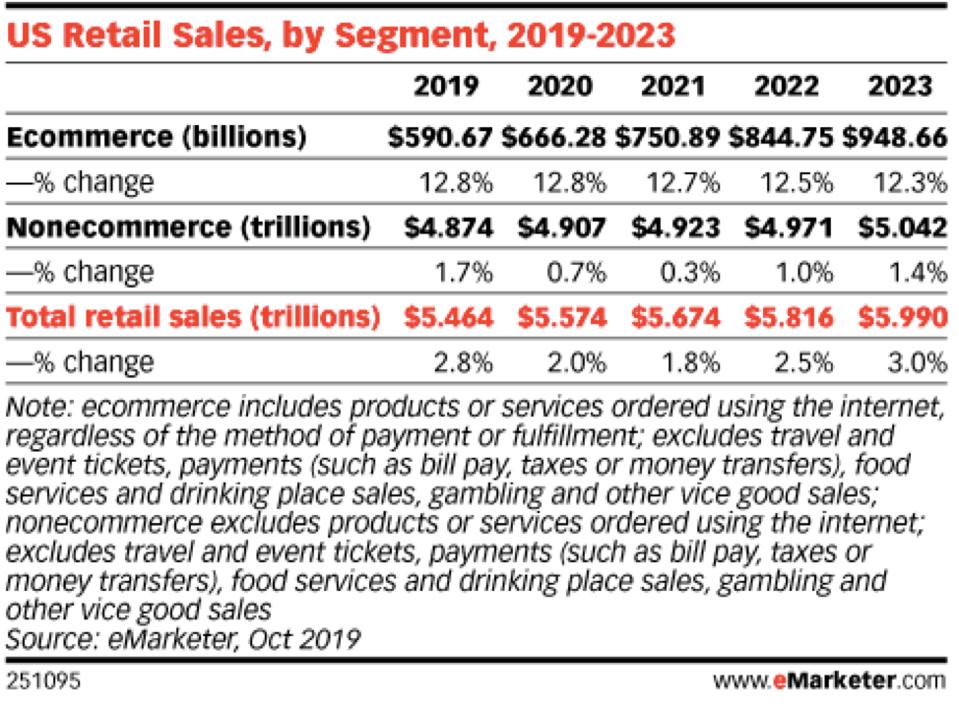
U.S. Retail Sales by Segment
EMARKETER
The consumer is ready to accept the mobile device as a mechanism to purchase products more readily today than in previous years. Influencing factors include more data storage, unlimited data plans, ease of use and consumer confidence with data protection. As a result, mobile users are adding more apps to their devices and converting more often from browser to purchaser.
According to Lipsman, “Retailers can optimize this new shopper behavior by not over-engineering the apps.” Part of the issue from a retailer perspective is the upkeep of developed apps, which can be time-consuming and tedious. However, Lipsman suggests, “Simplify the basics of app development by focusing on converting the shopper to a purchaser with ease of app usage and basic personalization.” Once you start layering in augmented reality and other AI technologies, it creates a more complex infrastructure requiring additional upkeep. However, some retailers have had success through a gradual increase in the functionality of mobile apps, leading to a more sophisticated model.

A customer applies digital makeup. (Photo by Rosdiana Ciaravolo/Getty Images)
GETTY IMAGES
Sephora launched its mobile app in 2010, which was developed to enhance the shopping experience and included minimal features like scanning products to see reviews and ratings. Over the past decade, the app has evolved and now features augmented reality and machine learning to help shoppers select the right make-up for their skin type, which has deepened the high trust with its more than 25 million loyal customers.
One of the biggest challenges for mobile commerce is what Lipsman calls the mobile monetization gap, referring to the variance between browsing on the mobile device and purchasing. For example, last holiday season, 75% of e-commerce shopping was done on a mobile device but only around 40% converted to a sale. This gap will be reduced both from the retailer and consumer perspective.
Julie Bernard, CMO at Verve, states, “Leading retailers have focused on improving mobile app design for improved consumer usability and overall experience, enabling customers to complete their purchase in-app as opposed to the days when a shopper might browse on a phone yet complete the purchase on the desktop.”
Cutting-edge companies have progressively layered in higher uses of AI to help with converting shoppers to purchasers as well. Bernard states, “Smart retailers have employed chatbots to deliver helpful customer service while on the mobile device; chatbots and mobile messaging capabilities will only continue to improve, further contributing to the commerce switch from stores and desktop to mobile.” Consumers are becoming more comfortable with using the mobile device for purchasing and the pain-point of check-out is minimized through mobile payments or saved payment information.
The move to 5G networks promises faster connectivity allowing shoppers to view products quickly, stream HD videos and consume content at a faster rate giving mobile devices the same advantages as a desktop.
Bernard says, “There is no doubt that 5G will have a notable and meaningful impact and leading innovative retailers would be smart to explore opportunities for their respective business models and consumer experience offerings.”
According to a recent World Economic Report, the five key functional drivers of 5G support certain technological applications including enhanced mobile broadband, ultra-reliable low latency communication, security, massive machine-type communications and power efficiency. The shift to 5G capabilities will drive mass development for artificial intelligence including augmented and virtual reality experiences and can foster a complete digitalization of a brand.
Zara has stated in its annual report an objective to become a fully digital platform this year including cross-synergies between digital and physical shopping preferences, seamless browsing across channels, and interchangeable features between technologies putting the customer at the absolute center of the shopping journey.
Complex IT infrastructure is not required for brands to develop a mobile strategy to drive user experience and increase customer engagement. Mobile strategies with a distinct purpose and deliberate goals are equally effective at driving a loyal following of shoppers. Depop, the creative community’s mobile marketplace, is a highly successful peer-to-peer social shopping app that has captured Gen-Z attention. The app’s strategy is eBay meets Instagram and it has become a gateway to influencer status for the generation enamored by YouTubers. Depop is based on the ease of use, the ability to transact seamlessly and the creativity inspired through the mobile app, all of which demonstrate clear goals set by the company. Although Depop did not respond to a request to comment, the app’s success is confirmed by the large size of its user base (over 13 million).
The effort put forth by retailers and brands to develop meaningful mobile experiences that synchronize the shopping journey across the multiple channels of commerce is driving shopper use and engagement on the mobile device.
Follow me on Twitter or LinkedIn.
 Follow me on
 I have over 25 years of experience as an executive in the retail industry across many functions including general management, marketing, operations, merchandising, buyi
…
